
This topic often comes up in conversation, and I often lead with “I don’t read nearly as much as I did before I started writing.” While that may be true, after doing a little back-tracking into 2019, I came up with a fairly healthy list of books that I somehow found the time to read.
I’d like to share that list with you, to include a few words about the titles or series. I’ll also link these titles to Amazon if you want to dig deeper. No affiliate income is derived from these links. I probably missed a few books…as I created the list, I thought of more.
LITERARY FICTION:
- We Were the Lucky Ones by Georgia Hunter – Heart wrenching, based on the true story about one Polish-Jewish family’s epic struggle to survive the World War II. Compelling from star to finish.
- YES…I need to expand this section in 2020!
HORROR:
- Head Full of Ghosts by Paul Tremblay – Modern day, sublime version of The Exorcist…and so much more. The end will blow you away.
- Disappearance at Devil’s Rock by Paul Trembly – Made me scared to get up in the middle of the night…again.
- The Outsider by Stephen King – King at his best. Read the book and then watch the HBO series. They compliment each other perfectly.
- The Institute by Stephen King – Loved this one. Had an epic feel. The end will leave you thinking hard for days to come.
- We Sang In The Dark by Joe Hart – (Not yet released) This one left me afraid of the dark for a while. Joe has a way of doing that with his novels.
THRILLER (Any subgenre):
- Recursion by Blake Crouch – Mind-blowing. Just get it right now and take this incredible journey.
- Don’t Make a Sound by T.R. Ragan – (Not yet released) Takes the revenge thriller to the next level in a gritty and chillingly realistic hunt for a killer.
- Origami Man by Matthew FitzSimmons – (Not yet released) Hard to beat the first four books in the Gibson Vaughn series, but FitzSimmons does it handily. Highly recommend the series!
- A Gambler’s Jury by Victor Methos – Underdog, scrappy lawyer caught up in vicious conspiracy. Edgar nomination for Best Novel.
- The Killer’s Wife by Victor Methos – Serial killers and a haunted prosecutor. Twists and turns galore.
- Pray for the Girl by Joseph Souza – Edgy, tense…will keep you guessing until the end.
- The Chain by Adrian McKinty – One of the most inventive premises I’ve read in a long time. Unputdownable.
- Green Sun by Kent Anderson – A hypnotic cop thriller set in early 1980’s Oakland, California. Couldn’t put it down.
- The Eighth Sister (Charles Jenkins Book 1) by Robert Dugoni – Flawlessly executed espionage novel and white-knuckle journey through the byzantine world of modern intelligence.
- The Last Agent by Robert Dugoni – (Not yet released) Book 2 in Charles Jenkins series. Knocks it out of the park with a full throttle cat and mouse spy story.
- The Killer Collective by Barry Eisler – A mashup of Eisler’s most iconic characters in full-tilt covert operations thriller.
- Dark Tomorrow (Lisa Tanchik Book 2) by Reece Hirsch – (Not yet released) Cyber-espionage and warfare amidst a high stakes federal manhunt for a murderous sleeper agent.
- The Spider Heist by Jason Kasper – Not your ordinary bank heist book. Not by a long shot. High octane action and twisty plot.
- The David Rivers Thrillers (Books 1-5) by Jason Kasper – Gritty, brutal, unapologetic action by a former Green Beret. Burned through these books one after another.
- Murder Board (Boston Crime Thriller Book 1) by Brian Shea – Brian Shea is the real deal. A veteran detective turned thriller author…It truly doesn’t get any better.
- The Little Drummer Girl by John le Carre – Classic le Carre. Meticulous. Sets the standard.
POST-APOCALYPTIC/DYSTOPIAN/SCI-FI:
- Bar at the End of the World by Tom Abrahams – Tom takes a killer premise and builds a dystopian world like you’ve never seen before.
- Winter World (The Long Winter Trilogy Book 1) by A.G. Riddle – Classic A.G. Riddle. End of the world story that takes reader across space and time.
- Solar War by A.G. Riddle – Book 2 in the Long Winter Trilogy. Riddle does what he does best…pushes the story to unimaginable places.
- Our War by Craig DiLouie – A second civil war burns out of control across America. Brilliant rendering of a worst case scenario that feels all too real.
- Sons of War by Nicholas Sansbury Smith – (Not yet released) As always, Smith reboots the post-apocalyptic genre with a unique story of a societal collapse.
- The Path Between Worlds by Paul Antony Jones – Epic, saga like potential set in a world beyond imagination, but eerily familiar.
- Forward Collection (short stories by Andy Weir, Blake Crouch, NK Jemisin, Paul Tremblay, Veronica Roth and Amor Towles) – Take your pick…you can’t go wrong with this powerhouse group of authors.
- The Second Sleep by Robert Harris – Eerie from start to finish. A slow burn, dystopian masterpiece.
NON-FICTION:
- Red Notice by Bill Browder – A sweeping indictment of Russian corruption and malice. Fast paced, expertly crafted. A must read.
- Bad Blood by John Carreyrou – Investigative masterpiece chronicling the rise and fall of Theranous, a nebulous and sinister Silicon Valley startup.
- The Road to Unfreedom by Timothy Snyder – Hard hitting book. “A stunning new chronicle of the rise of authoritarianism from Russia to Europe and America.“
- The Fifth Risk by Michael Lewis – “Masterfully and vividly unspools the consequences if the people given control over our government have no idea how it works.“


 HOT ZONE just hit the audiobook shelves at Audible and iTunes, so instead of a post with a single title, I thought I’d create a post listing all of my audiobook titles. A one stop reference for those of you with long commutes, long walks to take, long breaks at work OR those of you who simply don’t like to “READ.” I know who you are!


 WHAT IS THE ZULU VIRUS? Check out the description of the virus taken directly from the Black Flagged novels.



 1.) Adaptive Camouflage: Sometimes called “active camouflage,” this fledgling technology today will be fully developed and available to the military and highest bidder in the 2035 world created for Rogue State. You can imagine the tactical benefits of rendering a vehicle or operative invisible to the naked eye or infrared detection. Check out a few links describing today’s efforts to harness this technology. The image to the right is from the movie Predator, I couldn’t resist…the ultimate in adaptive camouflage.
 2.) Rifle mounted, goggle integrated cameras: This isn’t exactly something new, but it isn’t routinely fielded today. I got the idea from playing Call of Duty and did some research. Like anything that might provide the modern day field operative or soldier an advantage, companies are putting consider time and money into development. Consider the benefit of being able to stick your rifle around a corner, see a target and shoot it.
 3.) Facial Recognition Software is widely, publicly and openly used by law enforcement and government agencies in 2035. A few states have declared it unconstitutional and prohibit the use of FRS technology. This isn’t new either, but as far as we know, proactive, wide scale use by the government hasn’t been implemented yet—OR HAS IT? Here’s a quick paragraph from Rogue State describing the problem.
 5.) Taking advantage of the population resettlement, drug cartels from Mexico have seized control of most of Arizona and New Mexico. The U.S.-Mexico border no longer exists as a barrier in those areas, and fierce battles rage between well equipped cartel soldiers and National Guard units in key border cities along the Texas border. It’s fair to say that the State Department has issued a travel advisory to Americans thinking about vacationing in Mexico. Much of Rogue State takes place a few miles south of the border or in these lawless U.S. areas.
 7.) Mercenaries used by corporations to achieve their “goals.” You already got a good taste of this in Fractured State. CERBERUS is essentially a high-end mercenary outfit retained by corporations to safeguard their financial interests—or create new ones. In Rogue State, you’ll meet a slightly less refined group of mercenaries, comprised of former Russian Special Forces (GRU) operators. They specialize in murder and mayhem, which will unfold spectacularly and gruesomely.
 10.) A Bigger Plot Unfolds: I’ll talk more about this in the fifth Behind The Scenes article, but it will become clear to Nathan Fisher and David Quinn that the California Liberation Movement is far more than what it seems to the public. They’ll face a tough decision when confronted with the full scope of Jose’s plan.


 If you’ve read any of my books, you probably can guess that I like weapons. From knives to attack helicopters, I don’t shy away from the details, and I like my characters to make the best use of the weaponry available to them. Fractured State gave me the unique opportunity to take systems currently in development, and imagine them in widespread use 20 years from now. Every firearm is more compact and versatile, ammunition is far more lethal, heavy duty weapons systems normally employed by armies are now available to mercenary groups, and the effectiveness of personal protective equipment has increased to counter this new lethality. Take a look at the following links, along with a brief explanation of how I chose to employ that technology in Fractured State.
 Color night vision technology
 Smart grenade launchers
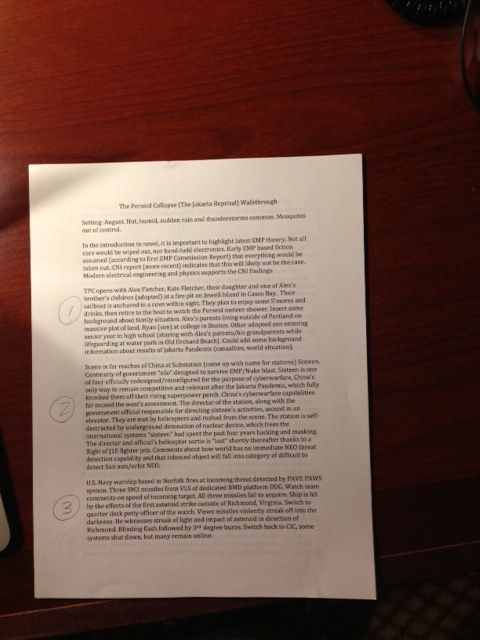
 1.) Creating a world to support a series requires me to create a ALTERNATE HISTORY, or in the case of Fractured State, a FUTURE set 20 years from today. Either way, I start out with a TIMELINE OF EVENTS. This is outside of the story plot. For the Fractured State series, I started in 2016 and envisioned the world, national, state and personal-level events that would land the reader on page one. As you can see, this sheet has endured coffee and beer stains, many on-the-fly changes and an accidental “throw away” since I created it in early 2015. It rarely leaves my side while I’m writing.


 For Fractured State, I spent a lot of time studying WATER sources in California, the rest of the southwest and the Great Plains. While the events in my story are purely fictional, the historic, ongoing drought in California and the U.S. Southwest is REAL. Frighteningly real. California’s current drought started me on the path to writing this series. The more I researched, the more I knew I had the background for an incredible story. What if the drought continued for another 20 years like many climatologists agree is possible? AND what if the effects of the drought were intensified by corrupt group of greedy industrialists and enforced by a ruthless mercenary army on their payroll? Secession? Mayhem?







You must be logged in to post a comment.